My cousin David died on Mother’s Day.
Of my nine first cousins, David was the closest to me in age, six months younger to the day. He would have turned 63 on July 21.
In many ways I related to David as if he were much younger than me. I suspect that is because he hadn’t ticked the boxes of “successful adulthood” as they were expected in our family. Marriage — check. Kids — check. Professional career — check. The reality, of course, is more complicated. David contended with far more in his six decades than I have in mine.
We grew up only a few miles apart, but David and I were not particularly close as kids. That cousin-closeness was with his sister Vivian, two years my senior. Sleepovers, Barbies, some overlap in friends — Viv and I led more parallel lives.
In childhood photos David is adorable. Bright eyes, freckled nose, sweet smile. Often a baseball uniform. At his funeral Vivian recounted David’s natural athletic ability and achievement. And while I envied Viv’s athleticism — she played tennis! — she admitted to envying her brother’s.
I don’t know why I wasn’t aware of the darkness that found David. It could be that my Aunt Trudy and Uncle Jack kept it under wraps. Or maybe my parents didn’t understand what was happening, or how to explain it to me. I didn’t see David much during our adolescence or young adulthood.
My memories of David come into focus once I settled into married life in my early 30’s. That’s when David and Carol, his beloved partner of more than 30 years, would come by, settle on our couch, and ask for diet pop. With ice. David would usually call before coming over, but not always. They spent many 4th of July evenings with us in our backyard. Dinner. Sometimes the neighborhood fireworks. Often Carol carried the conversation. Both she and David were friendly and appreciative and always engaged with my kids.
The mental illness that David and Carol both lived with resulted in a candor that was disarming and refreshing. They stated what they wanted, with neither sarcasm nor social graces. There was often large belching followed by “excuse me” and a cheeky smile. David was the family historian, remembering details and stories that I did not. He spoke often about our grandparents and their lives as immigrants in Detroit.
Sometimes I felt put upon by these visits. I had three kids at home and a million things to do. But the truth of it is that the time with David and Carol reminded me what our grandparents had preached. Family is the most important.
After my divorce, David and Carol stopped coming by. I suspect it was because David felt uncomfortable without Perry here. I would still see David, and often Carol, at holidays. When David stopped driving, and my kids got their licenses, my father would task them with transporting David to family events.
In the span of less than two years, David suffered a debilitating stroke, his beloved father died, he had to move into a group home away from Carol, and he had to bear the death of his dear friend Adam. The losses were enormous.
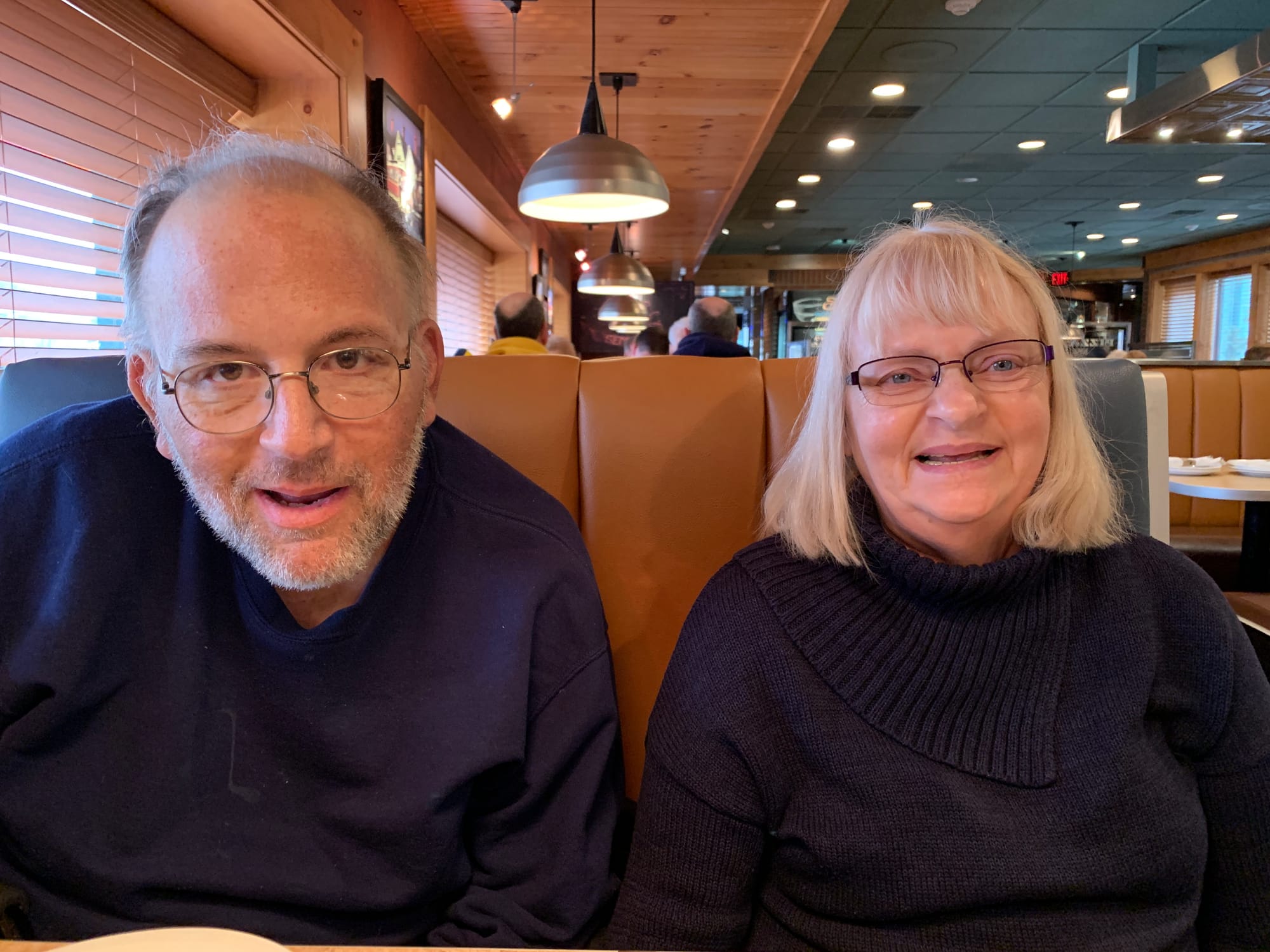
For a while I tried to take David and Carol out every month or so. I’d pick up Carol and then David, sometimes the other way around, and we’d go to Buddy’s — their favorite — where copious amounts of iced tea were consumed and garlic bread sticks and spaghetti for Carol and pizza and salad for David. They called each other Teddy Bear and Carol would try to hold David’s good hand under the table. I have a photo of the two of them sitting across from me in the booth. It is precious.
Twice we went to the movies, once during the polar vortex. I never felt like I was doing enough.
After COVID, before my dad’s death, as David’s physical health continued to decline, his sisters made the difficult decision to move him from Detroit to Cincinnati, where his oldest sister Miriam and her large and loving family are based. He needed more care and more attention than those of us here were able to give.
Once David moved, his phone calls increased exponentially. My sons talked to him daily, sometimes more than once. He called his nieces and nephews, his sisters, brothers-in-law, Carol, Carol’s sister, Carol’s mother, his former social worker, my mother, my ex-husband, me. There was always a joke. Usually more than one. Some off-color. Some cringe-worthy. Some truly funny.
David kept tabs on everyone. While calls were often brief, he seemed to know and ask about what was going on in each family unit.
From a distance, David became a hub. The center of a web. A touchpoint. Someone we all thought about and wondered about and were concerned about. Have you talked to David?
It hadn’t occurred to me until I stood at his graveside, weeping through the beautiful eulogies, how much my cousin David was like our Bubby.
Bubby Fayge was a tiny woman of incredible strength who had endured more than her fair share of unspeakable losses, health challenges, upheavals — and yet was the most glass-half-full person I have ever known. She could take a literal shmate and turn it into a pillow, a vest, a tissue box cover. But she also did this with life’s less tangible shmates. Always finding a way to make something meaningful.
Like our Bubby, David endured more than his fair share of unspeakable losses, health challenges and upheavals, and yet always seemed to find a way to move forward, to adapt, to meet his challenges without drama or self-pity, to make something meaningful out of what was left.
Standing before the simple pine casket I felt comfort thinking about David and Bubby Fayge. About these two people, born half a century and a world apart, whose lives were vastly different, yet whose spirit and soul seem cut from the same sacred cloth. Grandmother and Grandson. Centers of our family web.
Nearly thirty years after her death, I can still hear my Bubby’s voice. “Mamela, how var der kinder?”
I hope I will forever hear my cousin David’s as well. “What do you call a twitching cow?”
Comments
Sign in or become a Nu?Detroit member to join the conversation.
Just enter your email below to get a log in link.