A recent survey revealed an odd disjunction in the attitudes of American Jews toward Zionism and the State of Israel. According to the survey, around 90% of American Jews supported the existence of the State of Israel as a Jewish State, while only around one-quarter defined themselves as Zionists. For those of us who understand the definition and meaning of Zionism — the actual definition and meaning, not the way the term Zionism has been distorted beyond recognition — this disjunction is, to say the least, perplexing and confounding.
Simply put, the definition of Zionism is the belief that, based on the principle of national self-determination, the Jewish People, like other peoples, has a right to self-govern as a Jewish state in their ancestral homeland. Accordingly, the large majority of American Jews who support the existence of the State of Israel are, in fact, Zionists while many among them simultaneously believe that they are opposed to Zionism. This odd disjunction points to the disturbing success with which those who oppose the existence and legitimacy of the State of Israel have redefined the term Zionism into something it is not.
To be sure, this sort of redefinition is not new in the history of Judenhass [Jew hatred]. On the contrary, one of the signature features of Jew-hatred through the centuries has been an act of redefining Jews, Judaism, or, in this case, the Jewish State into something that is widely despised and feared. Christian antagonists of Jews redefined Jews as the minions of Satan; this invented theological premise made it easier for Christians to believe all sorts of heinous things about Jews: enemies of Christianity, poisoners of wells, and, of course, murders of Christian children to use their blood for demonic sacramental purposes. Along similar lines, nineteenth century racial thinkers who reiterated Jew hatred in racial terms (including Richard Wagner and the man who coined the term "antisemitism," Wilhelm Marr) recast Jews as a race threatening to destroy other races — or, Hitler's variation, a viral anti-race undermining humanity's natural racial struggle.
Antizionism, the latest paradigm of Jew hatred, has redefined Jewish peoplehood and the Jewish State in similarly menacing terms: Jews as white, European, and privileged, and the Jewish people and the Jewish State as racist, settler-colonialist, and genocidal.
These redefinitions have been an effective tactic for nearly two millennia, not least of all, because each has framed the debate between defenders of Jews and the Jewish State, on the one hand, and their antagonists in terms that favor the antagonists and disadvantage Jews and their supporters. Defenders of Jews and Judaism in the world of medieval Christendom, for example, were required to engage the presumptions of Christians and Christian dogma about Jews and Judaism as a given and as a point of departure. A common thread of medieval disputations between Jewish and Christian theologians (the most well-known being those in Paris in 1239, Barcelona in 1263, and Tortosa in 1412) was that Jewish participants were prohibited from impugning Christians and Christianity in any way, while their Christian opponents could malign Jews and Judaism as they saw fit. This meant that even the most adept defender of Judaism (Nachmanides in Barcelona) was arguing with one intellectual hand tied behind his back — and remarkably still played to a draw.
In the current polemical climate, too, invented claims that demonize Zionism are often treated as a given. Most proponents of these claims parrot them mindlessly and divorce them from historical reality, while those of us tasked with defending Zionism have to dismantle these claims. "Zionism as settler-colonialism" is no less ahistorical than the claim that Jews are in league with the devil; and each has empowered an innumerable host of people to feel that their hatred of Jews is somehow justified.
In this regard, a necessary and useful first step in refuting these claims is to retrieve the original and actual definition of Zionism from the margins of intellectual discourse and place it back to center stage where it belongs. This is no small task given that the distortion of Zionism began more than half a century ago and has been amplified significantly by the mind-numbing effects of social media.
A first step in this direction — like the first step in teaching many subjects to the unlearned and unfamiliar — is (re)teaching basic vocabulary, in this case beginning with the meaning of Zionism. Debates about the nature of Zionism, and especially the claim that Zionism is a form of colonialism (the basis for all of the other antizionist calumnies) is premised on the misconception that Jews are somehow not indigenous to the Land of Israel. Oddly, debates about the nature of Zionism typically gloss or skip over this essential point, even though the notion of Jewish indigeneity in Israel easily meets even the UN's working definition of indigeneity.
In addition to Zionism, other related terms are equally misconstrued and misrepresented, including:
Settler-Colonialism — How many know the origin and aim of the "settler" part of settler-colonialism?
Settlers/Settlement" — How many know that there are two different Hebrew words for settlers and settlement, mityashvim/hityashvut and mitnachalim/hitnachalut?
And, of course, the term Palestine itself — How many know that Palestine was a geographic term until 1948, used interchangeably with eretz yisrael?
Fortunately, we have template to guide us in this endeavor: Holocaust education. From the 1960s through the 1990s, the American Jewish community taught the rest of the country the history of the Shoah. Now we need to do the same with respect to Zionism and the State of Israel, and remove the stigma about Zionism that so many reflexively embrace.
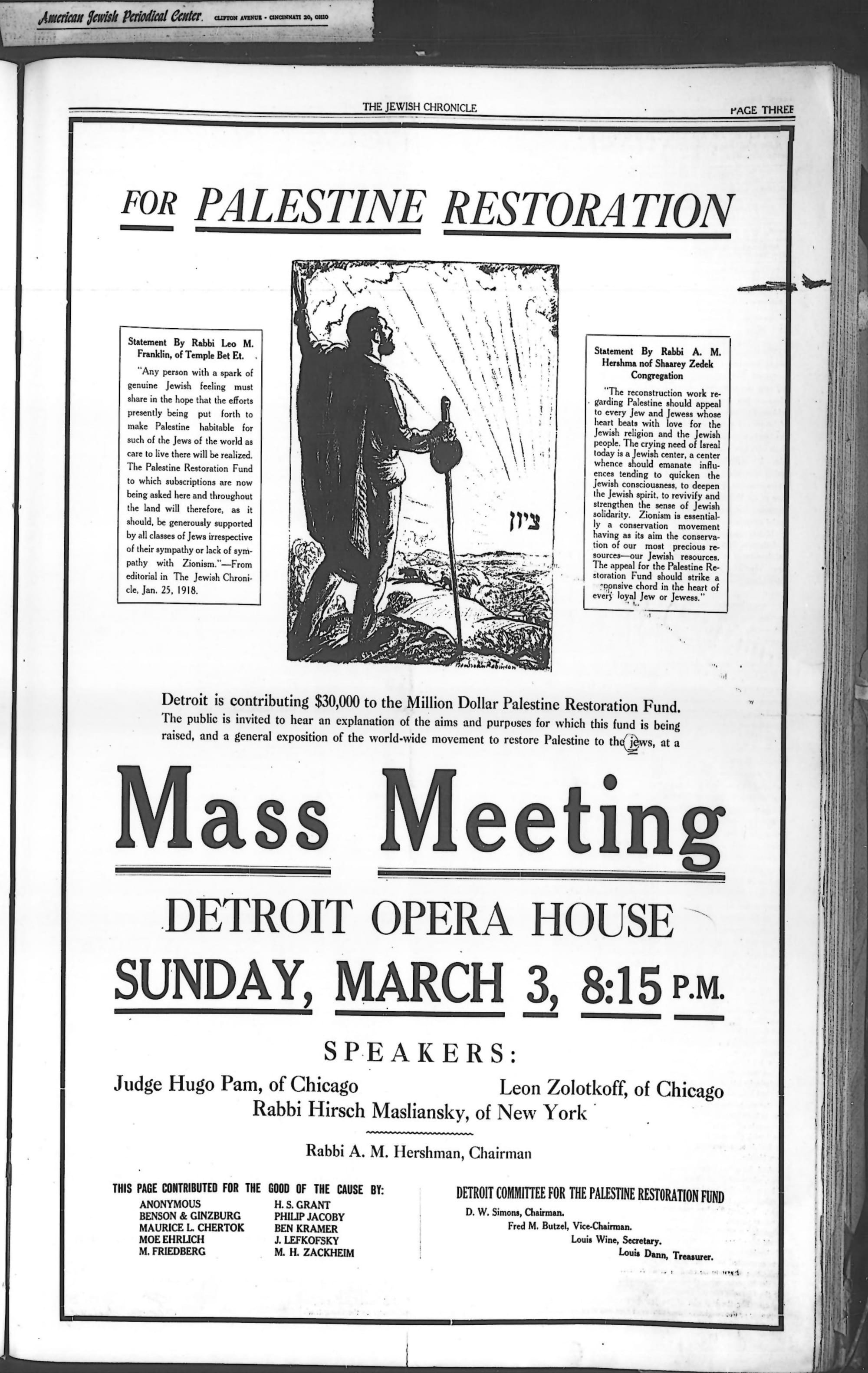
The Jewish Chronicle, March 1, 1918
Comments
Sign in or become a Nu?Detroit member to join the conversation.
Just enter your email below to get a log in link.