When I toured the American Cemetery in Margraten, Netherlands, earlier this year, something important was missing. But it wasn’t until last week that people everywhere learned just what had been removed from display — and why.
The American Battle Monuments Commission, in response to pressure stemming from the Heritage Foundation, has taken down the panel educating visitors about US military segregation and the treatment of Black soldiers.
Here is the material that was censored in response to allegations of ABMC’s “apparent disobedience”:
African American Service Members in WWII: Fighting on Two Fronts
During World War II, the U.S. military followed a strict policy of segregation. Despite the ongoing fight for civil rights at home during an era of racist policies, more than a million African Americans answered their nation's call enlisting in every branch of the military.
Although limited to serving primarily in labor and support positions, Black service members regularly faced the horrors of war. In the fall of 1944, the 960th Quartermaster Service Company (QMSC) — composed primarily of African Americans — arrived in Margraten to dig graves at the newly created cemetery. First Lieutenant Jefferson Wiggins of the 960th QMSC recounted the suffering of service members under his command who "cried when they were digging the graves ... they were just completely traumatized."
President Harry S. Truman finally ordered the US military to desegregate in 1948. However, African Americans' fight for civil rights was far from over. Many Black soldiers, including Wiggins, returned home to become leaders in the Civil Rights movement. The achievements of African American service members in WWII served as a powerful claim for equality then and now.
The White House and the Pentagon have picked the wrong battle in their attempt to whitewash Black military history. These historical revisionists underestimate the ability of the Limburg community and intrepid Dutch civil rights advocates to set the record straight. These activists, including the team at blackliberators.nl, have worked for years to share the largely hidden history of thousands of Black soldiers central to the allied campaign that freed the Netherlands in 1945.
Collaborating with political leaders, historians, students and Dutch volunteers who have adopted all 8,301 graves, they have focused on the Black Margraten burial unit. In addition, they have publicized the little known story of America’s segregated 761st and 784th combat units central to freeing many Dutch cities from the Nazis.
During the frigid Hunger Winter of 1944-45, Jefferson Wiggins and members of the all-Black Margraten burial unit wrapped 200 combat victims a day in mattress covers. These soldiers were laid to rest in graves often hammered out of the frozen ground with pick axes. Handling the bodies was the only time in their service that Black Margraten soldiers were allowed to come into direct physical contact with white comrades.
After every back breaking day at the Limburg burial grounds, Wiggins returned to his segregated school housing. The Blacks who did the heavy lifting never had a chance to break bread with their white commanders billeted in a castle.
“So there we were, a group of Black Americans confronted with all these dead white Americans,” recalled Wiggins. “I realized that we had to bury them, but when they were alive we couldn’t sit in the same room. Something isn’t right here.” Wiggins story is chronicled in From Alabama to Margraten by Mieke Kirkels.
Instead of being honored for their World War II bravery, America’s Black European soldiers were subject to Jim Crow discrimination ranging from separate blood banks and hospitals to being reassigned to another country for the “crime” of dating white Dutch women. Back home, they were effectively denied GI bill funding for college tuition and housing loans.
Thousands were attacked and, in some cases, lynched in their uniforms. This terror campaign horrified President Harry Truman who, in 1948, brought down the curtain on American military segregation that dated back to the War of 1812.
Old Heart, the film I produced, details the sole exception to World War II military segregation — the Red Ball Express. This integrated supply unit was critical to General Patton’s drive toward Berlin. Black and white soldiers loaded 6,000 trucks in Normandy with gas, weapons and bullets. Although 70 percent of the 23,000 drivers were black, the units drove east through minefields and enemy fire under the leadership of white commanders. Between August and November 1944, they moved over 400,000 tons of critical weapons, gas and supplies to Allies fighting Hitler’s Army.
Part of the broader problem, writes Kirkels, is that “hardly anything” can “be found in Dutch archives or historical books about the role” of the thousands of Black soldiers who served in the Netherlands. For example Soldier Dead, the definitive 2017 Columbia University Press reference book on fallen American military troops, “mentions the role of black men once.”
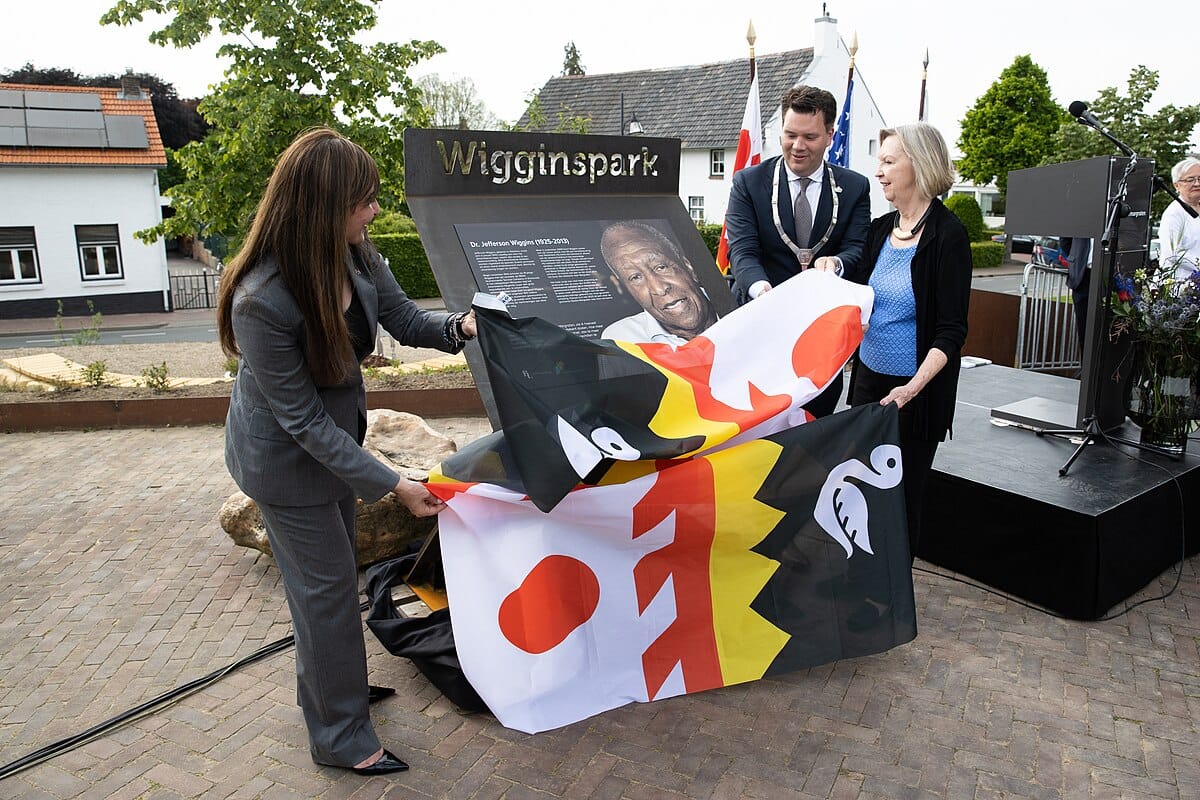
Thanks to the advocacy of Kirkels and the Black Liberators organization she cofounded, Wiggins Park was created near the Margraten cemetery. Dutch leaders all the way up to the Huis ten Bosch Palace in The Hague have paid their respects to members of the burial unit as well as the 174 Black soldiers laid to rest at Margraten.
The Governor of Limburg, representatives of 11 political parties, historians, and relatives of Black veterans are demanding that missing Black history panels be restored to the Margraten visitors center. This attempt to bury the story of Wiggins and his fellow Black veterans is now at the heart of a closely watched diversity, equity and inclusion battle. Thirty-four Democratic lawmakers have called for restoration of the panels including one honoring George Pruitt, who drowned trying to save a comrade who had fallen into a freezing river.
During his first Margraten visit last fall America’s new Dutch ambassador Joe Popolo defended the decision to take down the plaques honoring Wiggins and Pruitt:
"The displays at Margraten are not here to push an agenda criticizing America.”
His view is seconded by Paris-based American Battle Monuments Acting Secretary Robert Dalessandro, who believes the Wiggins plaque “never should have been there ... I was opposed to it long before the executive order was made and before Trump was elected."
It’s time for Secretary Pete Hegseth and the President to acknowledge the unique role and strategic contributions of Black soldiers tracing all the way back 1776.
Ambassador Joe Popolo, who donated $1.3 million to Trump and Republican campaigns last year, should restore the missing plaque now. If he fails to act promptly, it’s likely that replicas of the missing plaque will find a new home and attract more attention in nearby Wiggins Park.
Roger Rapoport is the producer/screenwriter of the feature film Old Heart about the hidden story of military segregation during World War II. Details are at oldheartmovie.com.
Comments
Sign in or become a Nu?Detroit member to join the conversation.
Just enter your email below to get a log in link.